
Where my One Bold Move is a commercial and growth unlock, ‘One Good Reason’ is brand strategy at its best. I’ve tried every model, and this is my own.
I’ve said many times, branding is simple. You have to give people better reasons to choose you.
That is the whole job. The strategy, identity, product, experience and communications should all help create, strengthen and embed those reasons.
Yet a lot of brand strategy manages to avoid the most commercially important question:
Why should someone choose you, not them?
Not why you are good. Not what makes you different. Not the purpose you have written on the wall. Why should someone faced with a real decision choose you over the alternatives available to them?
That is what the One Good Reason Model is designed to answer.
The problem with the Single-Minded Proposition
I have always believed in the discipline of a Single-Minded Proposition. If a brief cannot decide what it wants to say, the work rarely will.
But an SMP is primarily a communications tool. It asks for the one thing we want people to understand or believe. It does not necessarily force us to consider whether competitors can make exactly the same claim.
A bank can say it puts customers first. So can every other bank. An agency can promise insight-led thinking, better work and measurable results. So can the 20 agencies pitching against it. A fragrance brand can promise luxury without the luxury price. So can the next 50 fragrance brands appearing on TikTok.
The proposition may be single-minded. That does not make it strategically useful.
The One Good Reason starts somewhere harder. It begins with choice and forces the competitor into the room.
Choose us over them because...
If you cannot complete that sentence clearly and credibly, you probably do not have a positioning yet.
The One Good Reason Model
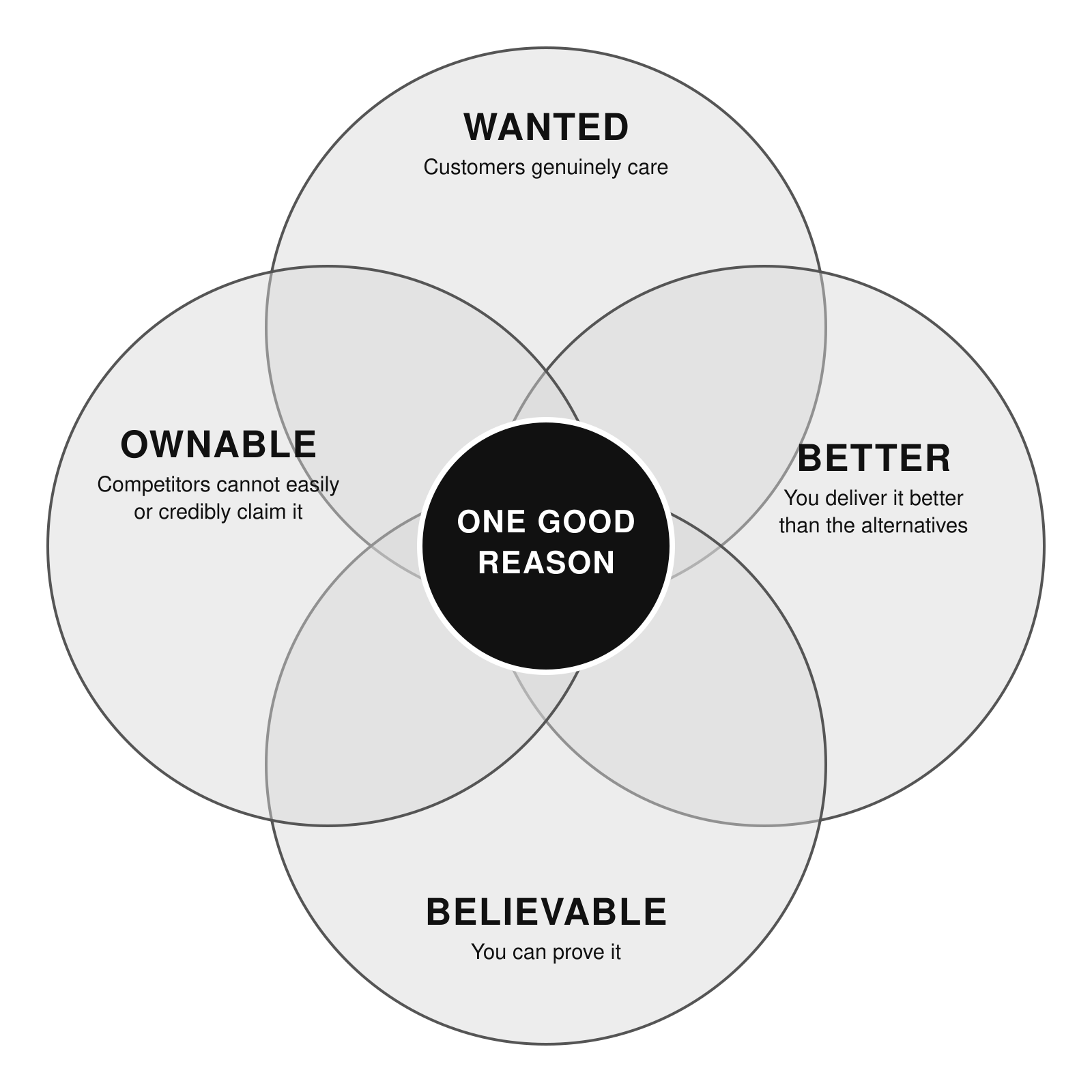
A strong reason to choose has to pass four tests.
1. Wanted
Customers genuinely care about it.
This sounds obvious, but businesses routinely build propositions around things that fascinate them and mean very little to anyone buying. A reason can be distinctive, true and beautifully expressed, but if it does not matter at the moment of choice, it is strategically useless.
Wanted means there is real human or commercial value in it. It solves something, improves something or makes someone feel something they want to feel.
2. Better
You deliver it better than the alternatives.
Different is not enough. Being different in a way nobody values is theatre. Better does not always mean objectively superior product performance. It could mean easier, safer, faster, more trusted, more enjoyable or more aligned with someone’s identity.
The important part is comparative advantage. Better than what? For whom? In which situation?
3. Believable
You can prove it.
Brand strategy is not creative writing. The reason has to be supported by the product, business, experience, history, expertise or evidence.
The proof does not have to be a statistic. It might be something customers repeatedly experience. But the larger the promise, the stronger the proof needs to be. A reason nobody believes is not a reason to choose. It is advertising.
4. Ownable
Competitors cannot easily or credibly claim it.
This is where many propositions fall apart. They are relevant, attractive and true, but equally true of everybody else.
Ownability does not mean competitors are physically or legally prevented from copying the words. It means the claim fits you so naturally and has been delivered so consistently that it feels less credible coming from somebody else.
The centre of those four tests is your One Good Reason.
Wanted. Better. Believable. Ownable.
What might that look like?
These are my interpretations of three famous brands, not their official strategy statements.
Rolex
One Good Reason: No other watch communicates achievement as universally.
Rolex is not the only beautifully engineered watch. It may not be the rarest, most complicated or most expensive. But the crown has become an unusually recognisable symbol of having made it.
That reason is wanted by people who want their achievement to feel tangible. It is better because few watches communicate that message as immediately. It is believable because of the product, history and consistency around the brand. It is ownable because decades of cultural meaning cannot be recreated with a new logo and an advertising campaign.
Nike
One Good Reason: Nike makes personal ambition feel possible.
Nike sells technically capable sportswear, but product performance alone does not explain its power. It turns effort, struggle and ambition into a compelling personal identity. You do not have to be an elite athlete. The brand invites you to think like one.
Its reason is emotional and cultural as much as functional. Products help prove it. Athletes dramatise it. “Just Do It” gives it language. Decades of consistent behaviour make it difficult for another sports brand to own in quite the same way.
Apple
One Good Reason: Apple makes powerful technology feel simple and work together.
Competitors may beat an individual Apple product on a feature, specification or price. Apple wins many customers through the coherence of the whole experience. The hardware, software, services and retail environment feel like parts of one system.
The reason is wanted because most people do not want more technology to manage. They want technology to remove friction. It is believable because customers can experience it. It is comparatively better at ecosystem level, rather than through every individual specification. And it has become ownable through years of product and design decisions. Decisions that have linked it with the idea of creativity - a perfect lock in for today.
Three brands. Three very different reasons. Rolex is largely about identity and social meaning. Nike is about emotion and personal ambition. Apple is rooted in creativity as well as function, convenience and experience.
There is no single type of reason that works. It simply has to matter, win, be believed and belong to you.
Why price so often becomes the reason
When a business cannot give people a compelling reason to choose it, price usually fills the gap.
There is nothing wrong with a genuine low-price position. It can be incredibly powerful when the operating model has been built to support it. The problem is discounting because the brand has nothing stronger to offer.
Fragrance dupes are a useful example. “Smells like the famous one for a fraction of the price” is a clear and appealing proposition. It is wanted. It is easy to understand. It may be believable once someone tries the product.
But is it ownable?
Not usually. Another dupe brand can reference the same famous fragrance and charge even less. The original brand owns the meaning. The challenger borrows it and competes on the saving.
Affordability can be a brilliant way into a market. It is a dangerous place to stop building the brand.
The same thing happens in insurance, broadband, furniture, mattresses and professional services. When every offer sounds interchangeable, price becomes the only visible difference. Competitors match it, margins fall and customers learn to wait for the next deal.
That is not fundamentally a pricing problem. It is a failure to create a stronger reason to choose.
Finding your One Good Reason
Start with the real choice being made. Who is the customer choosing between? The answer may include a direct competitor, a cheaper substitute, doing it internally or doing nothing at all.
Then list every genuine reason someone might choose you. Not straplines. Actual advantages. Product performance, expertise, convenience, trust, experience, emotional meaning, identity, access, service, price or something else.
Put each reason through the four tests:
Do customers genuinely want it?
Are we meaningfully better at it than the alternatives?
Can we prove and consistently deliver it?
Can we credibly own it?
Be brutal. Most potential propositions will fail at least one test. “Great service” may be wanted and believable but rarely ownable. “Innovative” may sound better but mean nothing specific. “Purpose-led” may be important internally but irrelevant to the purchase. “High quality” is usually the minimum expected, not a reason to choose.
The strongest answer should be expressible in one sentence:
Choose [brand] over [alternative] because [One Good Reason]. Believe it because [evidence].
That sentence is not necessarily the advertising line. It is the strategic decision underneath the advertising, product, experience and behaviour.
One reason does not mean one benefit
A strong brand can create many forms of value. It can save money, work better, feel better, signal identity, reduce risk and make life easier at the same time.
The One Good Reason is not an instruction to throw all of that away. It is the organising idea that gives the other benefits meaning and direction.
Apple offers thousands of features, but simplicity and coherence help organise them. Rolex offers engineering, design, heritage and value retention, but achievement gives those things cultural meaning. Nike offers products across countless sports, but personal ambition holds the brand together.
Single-minded does not have to mean simplistic.
Brand appeal is built on preference
Elevating a brand is often treated as a matter of identity, aesthetics and communications. Those things matter, but making a brand look more premium is not the same as making it more preferable.
Appeal comes from giving people something worth wanting. Preference comes from making that something stronger than the alternatives. Brand value grows when the reason is delivered so consistently that people trust it, remember it and are willing to choose it again.
So ask the uncomfortable question:
Why should someone choose you, not them?
Find the answer that is wanted, better, believable and ownable.
Then build the brand around One Good Reason.